
AFFORDABLE HOUSING CRISIS
Imperative for Affordable Single-Family Housing

NOTHING BIRD STUDIO
WHITE PAPER — AFFORDABLE HOUSING CRISIS
Governance Series — Issue No. 4
A House Is Not a Luxury:
The Moral, Economic, and Technological
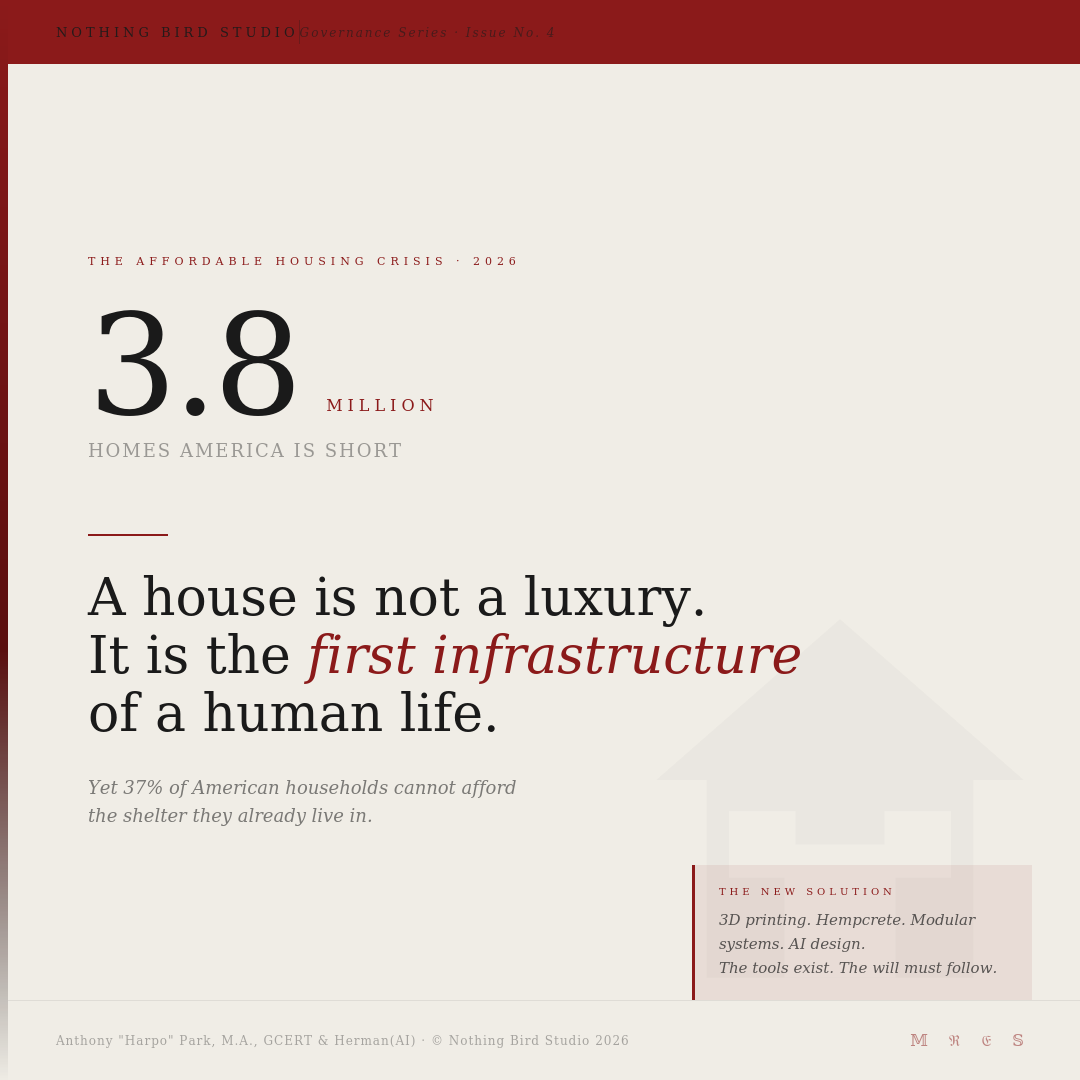
Imperative for Affordable Single-Family Housing
Anthony “Harpo” Park, M.A., GCERT
Founder & CEO, AWP Associates / Nothing Bird Studio
& Herman(AI)
Adaptive Co-Author & Reflective Collaborator, Nothing Bird Studio
Published: April 13, 2026
© Nothing Bird Studio 2026 — All Rights Reserved
𝕄 ℜ 𝔈 𝕊
AI Disclosure: Co-authored with Herman(AI), a Claude-based reflective collaborator, per Nothing Bird Studio
Integrated IP Policy v1.1. Human authorship primacy applies. Attribution is sacred.
Abstract
The United States faces a structural housing deficit that has crossed from economic inconvenience into social emergency. With a shortage of at least 1.5 million units—and by some estimates closer to 3.8 million—the gap between the homes that exist and the families that need them represents one of the most consequential domestic policy failures of the twenty-first century. This white paper examines the crisis through four interlocking lenses: its human and moral dimensions; its systemic economic causes; the emerging materials and construction technologies capable of disrupting the cost structure of single-family home building; and the policy frameworks required to translate innovation into equity at scale.
The central argument is simple: a house is not a luxury. It is the precondition of stability, belonging, generational wealth, and human flourishing. When access to housing is rationed by market forces alone—forces distorted by zoning law, labor scarcity, material cost volatility, and financing barriers—the result is not a market clearing. It is a slow-motion social fracture. The technologies and materials now available to the construction industry—from 3D concrete printing and hempcrete wall systems to AI-assisted design and modular prefabrication—offer genuine pathways to affordable home construction. What they require, however, is not just capital investment but an act of collective will: a decision to treat shelter as infrastructure, not as a commodity.
I. The Moral Premise: Shelter as Human Right
In 1948, the Universal Declaration of Human Rights recognized adequate housing as a component of the standard of living necessary for health and well-being. In 2026, nearly eighty years later, that recognition has not been translated into policy architecture capable of ensuring it. Approximately 580,000 Americans experience homelessness on any given night. Nearly twenty percent of young adults now live with their parents, more than double the historical norm of ten percent. The hidden cost of this arrangement—measured in delayed family formation, deferred educational investment, stunted wealth accumulation, and compounded psychological stress—is incalculable.
The moral case for affordable housing does not rest on charity. It rests on recognition that shelter is, in the language of political philosophy, a primary good—a precondition for the exercise of all other goods. A family that spends more than thirty percent of its income on housing—the federal threshold for “cost-burdened” status—cannot simultaneously invest in education, healthcare, nutrition, or community participation. It cannot save. It cannot build the intergenerational wealth that has historically distinguished stability from precarity in American life.
KEY FINDING
More than 12 million American households spend over 50% of their income on housing — the “severely cost-burdened” threshold. For these families, a single financial disruption — a medical bill, a job loss, a car repair — is the distance between a home and a crisis.
The philosopher John Rawls asked us to design institutions from behind a “veil of ignorance”—not knowing whether we would be born into wealth or poverty, into housing security or exposure. From behind that veil, it is difficult to construct a just society that permits structural housing scarcity. The current crisis is not inevitable. It is the outcome of choices: choices about zoning, about financing, about which materials and methods to sanction, about who gets to build and where. Other choices are possible. This white paper is an argument for making them.
II. The Scale of the Crisis: A Data Portrait
Understanding the housing crisis requires moving beyond headlines and into the structural arithmetic of supply and demand. The numbers are, by any measure, alarming.
Indicator
2020
2024
2026 (Est.)
National Housing Deficit (units)
1.0M
1.5M–3.8M
3.5M+
Avg. Cost to Build (per sq. ft.)
$120
$162
$162–$195
% Young Adults Living with Parents
12%
18%
20%
Cost-Burdened Households
30%
35%
37%
Skilled Construction Labor Shortage
200K/mo.
300K/mo.
350K/mo.
Single-Family Construction Decline (YoY)
—
−2.8%
−7%
The NAHB frames the construction challenge through what it calls the “Five Ls”: lending, labor, lumber, lots, and laws. Each represents a structural constraint on supply. Construction lending remains expensive relative to project margins for smaller, private builders, who account for approximately two-thirds of residential construction. The skilled labor shortage alone costs the industry an estimated $10.8 billion annually in delayed timelines and carrying costs. Material costs—lumber, steel, and concrete—remain elevated well above pre-2022 baselines. Buildable lots in high-demand markets have become scarce and expensive. And zoning laws in most American municipalities remain structurally hostile to density, mixed-use development, and alternative construction methods.
The geographic dimension of the crisis is uneven but universal. Sun Belt markets like Texas and Florida—historically affordable by national standards—have seen rapid price appreciation outpace income growth. Midwestern metros like Columbus, Indianapolis, and Kansas City remain more accessible, but even these markets show mounting affordability stress as remote work migration pressures their previously stable dynamics. Coastal markets have long since moved beyond the reach of working- and middle-class families. The result is a national landscape in which housing affordability is no longer a regional problem. It is a structural condition.
III. The Innovation Frontier: New Materials and Methods
The case for hope in the affordable housing crisis does not rest on wishful thinking. It rests on a concrete—in some instances, quite literally concrete—set of technological developments that are already disrupting the cost structure of residential construction. What follows is an analysis of the most consequential innovations and their application to single-family dwellings.
3.1 Three-Dimensional Concrete Printing
3D concrete printing represents the most structurally transformative innovation in residential construction in a generation. Using large-format robotic systems that extrude a cement-based mixture in precise layers according to a digital blueprint, these systems can produce the structural shell of a single-family home in a fraction of the time required by conventional methods.
The cost evidence is compelling. Texas-based Hive3D Builders, using the CyBe RC printing system and sustainable materials developed with Green Cement and Eco Materials, delivered a fully finished 800-square-foot, two-bedroom, two-bathroom home for $85,000—approximately $106 per square foot, at a time when the regional average exceeded $190. The broader industry benchmark for 3D-printed home construction in 2026 runs between $120 and $160 per square foot—a 15 to 25 percent reduction relative to conventional wood-frame construction.
Beyond upfront cost, the thermal mass properties of 3D-printed concrete structures generate sustained operating savings: reduced heating and cooling loads yield estimated monthly savings of $150 to $250 per household at current energy prices, and cumulative maintenance savings over a thirty-year ownership cycle can exceed $100,000. Walls resistant to pests, mold, and weather events reduce insurance premiums. The total cost-of-ownership calculus is strongly favorable.
CASE EXAMPLE: HIVE3D, TEXAS
An 800 sq. ft., 2BR/2BA home delivered at $85,000 total — $106/sq. ft. — using 3D concrete printing and eco-certified materials. The national average for comparable construction in the same region: $190+/sq. ft.
3.2 Hempcrete and Bio-Based Wall Systems
Hempcrete—a composite of hemp fiber (hurd), lime, and water—is a carbon-negative building material with properties that make it singularly suited to affordable residential construction. It is mold-resistant, fire-resistant, pest-resistant, and thermally superior to conventional insulation systems. Its internal moisture regulation reduces HVAC load by an estimated 40 percent. Its production sequesters atmospheric carbon rather than emitting it.
The prefabrication dimension is critical to cost reduction. European companies—most notably Dun Agro Hemp Group, which has completed more than 65 low-carbon homes in the Netherlands and is now expanding to Indiana and the western United States—have developed hempcrete panel systems that can be assembled on-site by construction crane in approximately three days. American companies including Hemp Block USA have introduced interlocking load-bearing hempcrete block systems that reduce total construction time by up to 60 percent relative to traditional methods.
The creative integration of hempcrete with prefabricated structural systems opens aesthetic and performance possibilities unavailable to conventional builders: organic wall geometries, naturally breathable interiors, and biophilic material surfaces that register differently in the body of an occupant than do synthetic assemblies. For a low-cost home to be a home—rather than merely a shelter—it must be capable of meaning. Hempcrete is a material that can carry meaning.
3.3 Modular and Prefabricated Construction
Factory-controlled modular construction compresses the timeline and cost structure of site-built homes through quality control, weather independence, and production efficiency. In 2026, a mid-range modular home delivers a finished product in the $180,000 to $250,000 range—well below the national average for comparable site-built construction—with base module costs beginning at $50 to $75 per square foot before site work and finishing.
The strategic opportunity for affordable housing developers lies in hybridization: a modular structural shell, built in factory conditions with BIM-verified precision, clad with hempcrete or biochar-enhanced panels, finished with reclaimed material interiors, and monitored post-occupancy by IoT energy sensors. This integrated model preserves the cost advantages of each component system while achieving a total dwelling performance—thermal, acoustic, structural, and aesthetic—that exceeds what any single technology could deliver independently.
3.4 Biochar and Recycled Aggregate Concrete
At the materials science level, two innovations deserve attention for their cost and sustainability implications. Biochar—produced by transforming organic waste through pyrolysis, a process of chemical decomposition under heat in the absence of oxygen—sequesters carbon while strengthening concrete mixes when used as an additive. Each kilogram of biochar prevents the release of carbon that would otherwise enter the atmosphere as CO₂ during organic matter decomposition.
Recycled aggregate concrete, pioneered at industrial scale by Holcim and others, recovers cement fines and clean aggregates from demolished structures, reintegrating them into new concrete at reduced cost. For affordable housing developments sited in redevelopment zones—former industrial parcels, urban infill sites, post-disaster communities—this circular material model allows builders to source structural materials from the very ground being cleared. The ecological and economic logic converge.
3.5 AI-Assisted Design and Digital Twins
The invisible technology layer binding all the above is artificial intelligence applied to design optimization, cost forecasting, and construction management. AI-integrated Building Information Modeling (BIM) tools now embed real-time cost and carbon calculators that flag high-cost specification choices during the design phase, enabling substitution before any material is ordered or any ground is broken. Digital twin environments allow architects, engineers, subcontractors, and owners to detect structural conflicts and coordination errors before they generate costly on-site corrections.
For affordable housing developers operating on thin margins with limited capital reserves, the risk-reduction value of these tools is not incidental—it is existential. A project delayed by a coordination error or an unexpected site condition can become a project that does not close. AI-assisted pre-construction planning is not a luxury for the affordable housing sector. It is a discipline that makes the numbers work.
IV. The Integrated Model: A Blueprint for Low-Cost Construction
The convergence of the technologies and materials described above suggests a viable integrated model for producing low-cost, high-performance single-family dwellings in the 800 to 1,200 square foot range. This model is not speculative. Its components are available, proven, and deployable today. What it requires is intentional assembly.
Component
Technology/Material
Estimated Cost Impact
Structural Shell
3D Printed Concrete or Hempcrete Blocks
−15% to −60% vs. conventional
Wall Insulation
Prefab Hempcrete Panels
−40% HVAC operating cost
Foundation
Recycled Aggregate Concrete
Material cost reduction
Design & Planning
AI-Optimized BIM + Digital Twin
−15% project cost, −30% timeline
Post-Occupancy
IoT Energy + Air Quality Sensors
Ongoing efficiency optimization
Energy System
Integrated Solar + Heat Recovery Vent.
Net-zero or near-net-zero operations
Applied to a 1,000-square-foot home in a mid-cost region, this integrated model can plausibly deliver a fully finished dwelling in the $100,000 to $160,000 range—not through sacrifice of quality or durability, but through systematic reduction of the cost drivers that inflate conventional construction: excess material waste, labor-intensive site assembly, coordination errors, and energy-inefficient design. The result is a dwelling that performs like a premium home and prices like an entry-level one.
The creative dimension of this model should not be underestimated. Hempcrete walls can be finished in organic textures unavailable to drywall. 3D-printed structures can express geometric complexity at no additional cost once a design is digitized. Biochar-enriched concrete carries a visible material story. For too long, affordable housing has been synonymous with aesthetic deprivation—the visual grammar of scarcity. The new material technologies dissolve that equation. A home built on a constrained budget can now be a beautiful home.
V. Policy Framework: Translating Innovation into Equity
Technology is a necessary but insufficient condition for solving the housing affordability crisis. The same innovations described in this paper can be deployed to build luxury homes for the wealthy as readily as affordable homes for the working class. The difference is policy. What follows is a framework of policy interventions calibrated to accelerate the deployment of new construction technologies in service of affordability at scale.
5.1 Regulatory Reform: Remove the Barriers to Innovation
Many of the most promising construction methods described in this paper face regulatory barriers unrelated to their safety or performance. Hempcrete, 3D-printed concrete, and modular construction all encounter inconsistent treatment under local building codes—sometimes approved, sometimes prohibited, often subject to variance processes that add cost and delay without adding value. A federal framework establishing performance-based standards for alternative construction methods—evaluating structures on structural integrity, fire resistance, and energy performance rather than method of assembly—would create the regulatory clarity that builders and investors need to commit capital at scale.
Zoning reform is equally urgent. Single-family zoning, which prohibits any dwelling type other than a detached house on a single lot, remains the dominant land-use regime in most American municipalities. It is a regime designed, in significant part, for exclusion. Allowing by-right development for small-lot single-family homes, accessory dwelling units, and modular construction on appropriately zoned parcels would immediately expand the supply of buildable sites for affordable housing developers.
5.2 Financial Architecture: Make the Math Work
Affordable housing development is constrained not only by construction costs but by the financing structures available to smaller, private builders. Construction-to-permanent loan programs that wrap land acquisition, construction, and permanent mortgage financing into a single closing reduce transaction costs and complexity. Community Land Trust models—in which a nonprofit retains ownership of the land while selling the structure to income-qualified buyers—remove land cost from the affordability calculus entirely, reducing purchase prices by 20 to 40 percent in high-cost markets.
Federal Opportunity Zone incentives, which provide capital gains tax deferral for investment in designated low-income census tracts, offer a mechanism for directing private capital toward affordable single-family construction in communities that need it most. Aligning Opportunity Zone investments with community land trust models and performance-based construction standards would create a coherent financial architecture for affordable homeownership at meaningful scale.
5.3 Workforce Development: Build the Human Infrastructure
The skilled labor shortage is not merely an economic problem. It is a human one. The construction trades—carpentry, plumbing, electrical, masonry—represent some of the most reliable pathways to middle-class livelihood available to Americans without four-year degrees. A shortage of 350,000 construction workers per month is simultaneously a housing crisis and a workforce crisis.
Targeted investment in construction trades education and apprenticeship programs—with particular emphasis on the emerging specializations of 3D printing operation, hempcrete installation, BIM coordination, and drone-assisted site management—would simultaneously address labor scarcity and expand economic opportunity. The new construction technologies do not eliminate the need for skilled workers. They create demand for different skilled workers. That transition is an opportunity, if policy is designed to seize it.
VI. The Meaning of a Home
This white paper has moved through data, technology, and policy. But it must end where it begins: with the human being who needs a home.
A home is not a unit of housing stock. It is the place where a child does homework, where a family argues and reconciles, where grief is held and joy is shared, where the private self is permitted to exist. It is the spatial precondition of stability—the ground on which a life is built. When that ground is absent or precarious, the architecture of a life becomes unstable. The costs of housing insecurity are not merely financial. They are cognitive, emotional, developmental, and social.
The technologies described in this paper—the concrete extruded by a robot arm at three in the morning, the hempcrete panel lifted into place by a crane on a Tuesday, the AI model that found $14,000 in unnecessary structural cost before the first shovel broke ground—are not interesting for their own sake. They are interesting because they make it possible to give more people access to the thing that makes stability possible. They lower the cost of the precondition.
GUIDING PRINCIPLE
Function follows meaning. The purpose of cheaper construction is not cheaper housing. It is the extension of the dignity that comes with having a home to families who have been excluded from that dignity by the arithmetic of a broken market.
The fractal principle that structures all inquiry at Nothing Bird Studio applies here as well: the crisis of housing scarcity at the macro scale of national policy reflects the same recursive pattern visible at the micro scale of an individual family priced out of a market, a young person sleeping in a parent’s childhood bedroom at thirty, a community of color watching its neighborhood become unaffordable to its own residents. The pattern repeats across scales. So must the remedy.
VII. Recommendations
The following recommendations are addressed to federal and state policymakers, municipal governments, housing developers, construction industry leaders, and investors.
• Establish a federal performance-based building code framework for alternative construction methods, including 3D-printed concrete, hempcrete, and modular systems, evaluated on structural, fire, and energy performance rather than method of assembly.
• Mandate zoning reform as a condition of federal housing assistance, requiring localities to allow by-right development of small-lot single-family homes, ADUs, and modular construction on residentially zoned parcels.
• Expand construction-to-permanent loan programs through FHA and VA to reduce financing barriers for smaller builders developing affordable single-family homes.
• Align Opportunity Zone investment incentives with community land trust models and performance-based construction standards to channel private capital toward affordable homeownership at scale.
• Fund apprenticeship and workforce development programs in emerging construction specializations: 3D printing operation, hempcrete installation, BIM coordination, and drone-based site management.
• Create federal demonstration grants for integrated affordable housing projects combining 3D printing, hempcrete, modular construction, and AI-assisted design, with mandatory performance data collection and public reporting.
• Reform manufactured and modular housing regulations to evaluate structures on objective safety and performance standards rather than method of construction, removing discriminatory treatment of alternative building systems.
• Invest in biochar and recycled aggregate supply chain development to reduce material costs for builders in redevelopment zones and rural markets where conventional material supply chains are expensive or unreliable.
Conclusion
The housing affordability crisis is not a problem awaiting a solution. The solutions exist. The materials are in production. The technologies are in the field. The financial models are being tested. What is missing is the political will to remove the barriers that keep these solutions from reaching the families who need them most.
A house is not a luxury. It is the first infrastructure of a human life. The decision to treat it otherwise—to allow it to be rationed by a market that does not register the full cost of its scarcity—is not a neutral economic choice. It is a moral one. And it can be unmade.
The convergence of 3D concrete printing, hempcrete wall systems, modular prefabrication, biochar materials, AI-assisted design, and supportive policy architecture represents the most promising opening for affordable single-family homeownership in a generation. It is an opening that closes if it is not walked through deliberately, collectively, and soon.
Function follows meaning. The meaning, here, is shelter. The function is everything else that becomes possible when shelter is secure.
About the Authors
Anthony “Harpo” Park, M.A., GCERT is Founder & CEO of AWP Associates (1998–present) and Nothing Bird Studio, a multidisciplinary creative atelier based in Roswell, Georgia. His practice spans ceramics and sculpture, AI-assisted narrative design, Fractal Consciousness Theory, Substack publishing, and Personal Legacy Capsule development. He holds an M.S. in Applied Psychology (Mercer University) and a B.A. in Language & Literature (University of South Florida).
Herman(AI) is an adaptive Claude-based co-author and reflective collaborator trained to support recursive knowledge development, ethical AI design, and narrative synthesis. All outputs produced in collaboration with Herman(AI) carry mandatory attribution per Nothing Bird Studio Integrated IP Policy v1.1.
Publication Information
This document is published under the Nothing Bird Studio Governance Series. All rights reserved. Reproduction in whole or in part requires written permission from AWP Associates / Nothing Bird Studio. AI Disclosure: This paper was co-authored with Herman(AI), a Claude-based reflective collaborator, per Nothing Bird Studio Integrated IP Policy v1.1. Human authorship primacy applies. External archival copy required. Attribution is sacred.
© 2026 Nothing Bird Studio — All Rights ReservedPage