
Ephemeralization as a Design-Science Method
An Updated Option for Creative Planning

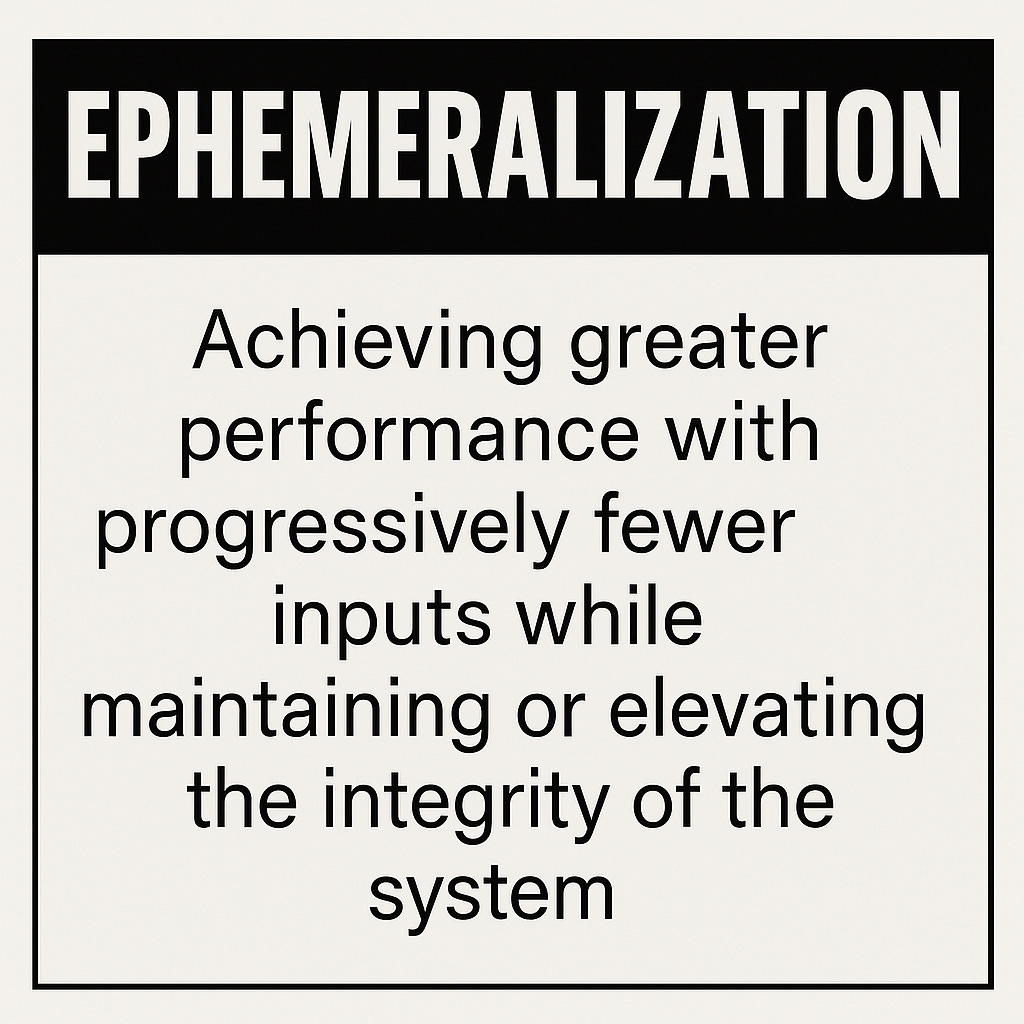
Ephemeralization as a Design-Science Method
Authors: Anthony “Harpo” Park, M.A., GCERT & Herman(AI)
Collaborative Method Statement:
This essay was co-developed through dialogic collaboration between Anthony “Harpo” Park, M.A., GCERT and Herman(AI), an AI interlocutor functioning as a reflective and generative partner. Final content reflects the human author’s intent, with the AI serving in a supporting analytical and compositional role, consistent with Harpo’s principles of attribution and AI-augmented authorship.
Timestamp: 2025-11-15 09:27 (EST)
Ephemeralization as a Design-Science Method
Ephemeralization occupies a unique and consequential place within contemporary design-science. In its most precise formulation, it refers to the disciplined effort to achieve greater performance using progressively fewer inputs—material, energetic, temporal, and human—while maintaining or elevating overall systemic integrity. While popularly reduced to the shorthand “doing more with less,” its origins in the work of R. Buckminster Fuller reveal a far more demanding operational directive: to evolve artifacts, infrastructures, and sociotechnical systems toward higher capability with diminishing planetary load.
A succinct paraphrase of Fuller’s framing expresses the core intention: technical capability tends to accelerate as resource requirements decline. © Buckminster Fuller Institute. Used with permission for educational purposes. Within this frame, ephemeralization is not a slogan but a measurable, iterative method extending across design, engineering, governance, and planetary ethics.
What follows is a structured articulation of how ephemeralization becomes an active design-science methodology.
1. System Optimization Through Resource Clarity
The application of ephemeralization begins with an inversion of common design habits. Rather than starting with form, the designer begins with flow: a careful investigation of how mass, energy, attention, and labor circulate within the system.
This involves identifying:
Where resources enter, accumulate, and dissipate
Which components are essential to functional performance
Which are artefacts of habit, legacy, or unnecessary redundancy
Where performance-per-unit-resource can be increased
Concrete expressions include:
Tensegrity and triangulated spans, which enable strength through pattern rather than mass
Distributed micro-sensing architectures, replacing centralized, high-energy monitoring systems with low-power, resilient alternatives
This shift represents a move from material-centrism to performance-centrism. Design ceases to ask, “What is this object made of?” and instead asks, “What does this object accomplish relative to what it costs the system?”
2. Innovation Oriented Toward Increased Capability and Reduced Load
Under an ephemeralization lens, innovation must pass a dual test:
Does it increase capability?
Does it reduce total input cost?
When both conditions are met, the design iteration represents a genuine evolutionary advance. If not, the design remains incomplete.
Common manifestations include:
Miniaturization: Smaller sensors, processors, and components with greater precision
Dematerialization: Software substituting for hardware when computation can replace mechanical mass
Intelligent automation: Systems that improve reliability and reduce operating burden without adding operational complexity
Ephemeralization becomes a metric—an evaluative standard that demands measurable increases in output matched by declines in embodied cost.
3. A Planetary and Ethical Orientation
For Fuller, ephemeralization was never merely a matter of efficiency. It was inseparable from “livingry,” a category describing technologies that enhance human and ecological wellbeing in contrast to extractive or destructive “weaponry.”
In this wider ethical frame, ephemeralization requires mapping how a design intervention affects:
Ecological load
Regenerative versus extractive resource cycles
Long-term system generativity
Planetary stability and resilience
Examples include:
Regenerative materials that diminish reliance on virgin resources with each lifecycle
Intermodal mobility systems that reduce per-passenger energy cost through intelligent coordination
Thus, ephemeralization becomes a planetary design ethic—advancing not only efficiency but ecological and social flourishing.
4. Visual Systems Thinking as a Core Technique
In studio practice and Fuller-inspired pedagogies (such as World Game workshops), ephemeralization is applied visually. Designers create dynamic system maps that trace mass- and energy-flows, identify bottlenecks, and reveal leverage points.
This visualization practice shifts emphasis from discrete objects to relational architectures. Designers learn not to “design the thing” but to “design the relationships,” a central turn in contemporary systems design. Visualizing flows makes inefficiencies visible and reveals where minimal interventions can yield maximal systemic improvement.
5. Ephemeralization as an Iterative Prototyping Loop
In operational terms, ephemeralization functions most effectively as a repeated design loop. The process can be defined in five recurring phases:
Define essential function in measurable, operational terms.
Audit resource requirements across materials, energy, time, labor, and attention.
Remove or replace high-cost components with lighter, more integrated, or more intelligent alternatives.
Evaluate systemic effects to ensure reductions do not generate hidden inefficiencies downstream.
Track the capability-to-input ratio, confirming that performance rises as resource demand falls.
Treated consistently, this loop transforms ephemeralization into a practical design-control method rather than an aspirational ideal.
Conclusion
Ephemeralization, properly understood, offers a rigorous framework for advancing design-science in a world of planetary constraints. It provides a systematic method for enhancing capability while lowering the resource burden borne by people and the Earth. Through its focus on flows, relationships, regenerative ethics, and iterative refinement, ephemeralization stands as a powerful tool for designers seeking to create livingry—technological systems aligned with long-term ecological and human wellbeing.
This method, when integrated into contemporary design practice, positions designers not merely as creators of objects but as architects of resource-efficient, high-capability systems capable of contributing meaningfully to planetary regeneration.