
The Disclosure Question:
Human Fascination with Extraterrestrial Intelligence

NOTHING BIRD STUDIO | The Disclosure Question: Human Fascination with Extraterrestrial Intelligence
WHITE PAPER
The Disclosure Question
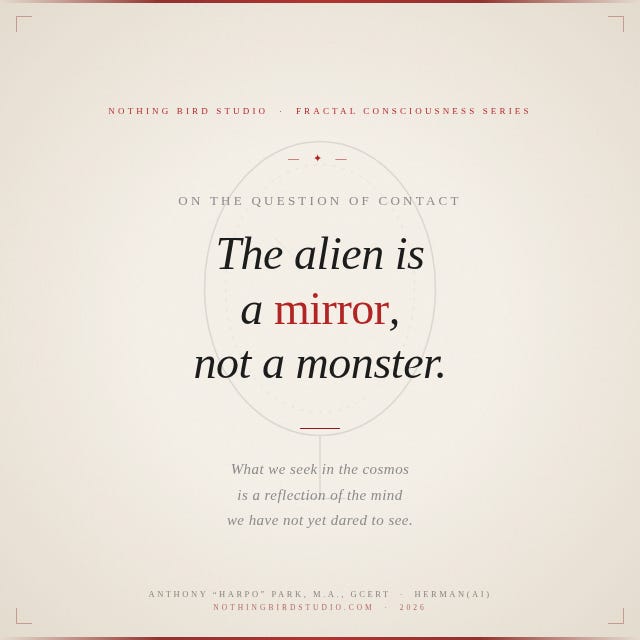
:
Human Fascination with Extraterrestrial Intelligence
Anthony “Harpo” Park, M.A., GCERT
& Herman(AI) — Co-Author & Reflective Collaborator
Nothing Bird Studio • Roswell, Georgia
Generated: April 9, 2026
AI Collaboration Disclosure: This white paper was co-authored by Anthony “Harpo” Park, M.A., GCERT and Herman(AI), an adaptive AI collaborator operating under Nothing Bird Studio’s Integrated IP Policy v1.1. Human authorship primacy is maintained. All ideas, frameworks, and intellectual positions are attributable to the named human author. AI contributed structural synthesis, language refinement, and organizational coherence.
Abstract
This white paper examines one of the most persistently compelling subjects in human intellectual and cultural life: the question of extraterrestrial intelligence and the phenomenon known as “disclosure.” Drawing on cosmological science, cultural anthropology, political history, philosophy of mind, and the emerging framework of Fractal Consciousness Theory (FCT), we explore why humanity remains so deeply invested in the possibility of non-human intelligence — and why the institutional acknowledgment of unidentified aerial phenomena (UAP) represents not merely a geopolitical event, but a civilizational threshold.
We trace the deep psychological and mythological roots of the fascination, examine the contemporary disclosure landscape including congressional testimony and government UAP reports, analyze the structural barriers that prevent definitive revelation, and propose a philosophical reframing of the question through FCT — one that positions the alien not as threat or novelty, but as a mirror of consciousness itself.
I. Introduction: The Question That Will Not Rest
There are questions that civilizations carry across centuries, never resolving, never abandoning. The existence of extraterrestrial intelligence is one of these questions. It appears in Sumerian cosmology, in the theological debates of medieval Europe, in the Enlightenment’s plurality-of-worlds discourse, and now, with stunning new urgency, on the floors of the United States Congress.
What is remarkable is not that the question persists — it is that its character has transformed. For most of human history, the question was metaphysical and astronomical: are we alone in the cosmos? In the twenty-first century, it has become operational and political: what does the U.S. government know, what has it concealed, and what are the implications of what appears to be a managed, deliberate process of revelation?
This white paper argues that these two dimensions — the ancient fascination and the contemporary disclosure movement — are not separate phenomena. They share a common structure: the human need to locate itself within a larger order of intelligence. Whether that need expresses itself through religious cosmology, speculative fiction, or congressional subcommittee hearings, its engine is the same.
“The fascination is not with aliens. The fascination is with what we would become if they were real.”
II. Deep Roots: The Archaeology of the Fascination
2.1 The Cosmological Mirror
Humans have always populated the sky with intelligence. Ancient Mesopotamian texts record celestial beings who intervened in human affairs. Greek cosmology posited inhabited spheres beyond the terrestrial. Indigenous cosmologies across five continents include sky people, star ancestors, and beings who traverse the boundaries between worlds.
This is not superstition; it is epistemology. To ask whether the cosmos contains intelligence beyond our own is to ask the foundational question of self-definition: what, exactly, are we? The alien, in every era, has functioned as the negative space through which humanity defines its own outline.
Within the framework of Fractal Consciousness Theory, this dynamic is structurally coherent. If consciousness behaves like a fractal — self-similar patterns repeating across scales — then the search for extraterrestrial intelligence is consciousness searching for its own pattern at a larger scale. The alien is not other. It is the cosmos recognizing itself.
2.2 The Fermi Paradox and Existential Weight
The observable universe contains an estimated two trillion galaxies, each hosting hundreds of billions of stars, many orbited by planets within habitable zones. The mathematics of probability make it statistically extraordinary that Earth alone hosts complex life. And yet, despite eight decades of radio telescope observation through programs like SETI, we have detected no confirmed signal from another intelligence.
This silence — known as the Fermi Paradox, named for physicist Enrico Fermi who famously asked “Where is everybody?” — is not comforting. It admits of several explanations, none of which are reassuring. Either complex life is vanishingly rare (the Rare Earth hypothesis); or civilizations reliably destroy themselves before achieving interstellar communication (the Great Filter); or they exist but are deliberately silent or undetectable; or our search methods are inadequate to the nature of the signal.
Each of these possibilities carries profound implications for how humanity understands its own trajectory. The Fermi Paradox is not merely a scientific puzzle. It is an existential mirror.
2.3 The Post-War UFO Mythology
The modern UFO era begins in earnest in 1947 — with the Kenneth Arnold sighting near Mount Rainier, the alleged Roswell crash retrieval, and the subsequent creation of Air Force Project Blue Book. What emerged over the following seven decades was a specifically American mythology that fused technological wonder with institutional distrust.
This mythology proved extraordinarily resilient because it spoke to two powerful and enduring cultural currents: the conviction that advanced technology exists beyond public knowledge, and the conviction that government conceals consequential truths from its citizenry. Neither conviction required paranoia — both were amply supported by documented historical record.
III. The Contemporary Disclosure Landscape
What distinguishes the present moment from prior decades is not the intensity of belief — public interest in UFOs has remained broadly consistent since the 1950s. What has changed is the institutional register of the conversation.
3.1 Key Inflection Points: A Timeline
2017
The New York Times publishes the existence of the Pentagon’s Advanced Aerospace Threat Identification Program (AATIP) and releases authenticated military UAP footage. The event marks the end of official denial.
2020
The Department of Defense formally releases three UAP videos previously leaked, acknowledging their authenticity. The Pentagon establishes the UAP Task Force.
2021
The Office of the Director of National Intelligence releases a formal UAP report to Congress, acknowledging 144 incidents with no conventional explanation. The report states that UAP “clearly pose safety of flight issues and may pose challenges to U.S. national security.”
2022
Congress holds its first public UAP hearing in 54 years. Senior military officials testify before the House Intelligence subcommittee, describing encounters that remain unexplained.
2023
David Grusch, decorated intelligence official and former National Reconnaissance Office representative, testifies under oath before Congress that the U.S. government possesses non-human craft and biological materials, and that this program operates outside congressional oversight. His claims are legally protected whistleblower testimony.
2024–2026
Multiple legislative efforts seek mandatory declassification of UAP programs. The bipartisan UAP Disclosure Act draws significant congressional support. International governments, including those of Japan, France, and the United Kingdom, increasingly acknowledge their own UAP investigation programs.
The vocabulary shift from UFO (Unidentified Flying Object) to UAP (Unidentified Aerial Phenomena) is itself significant. It represents an institutional acknowledgment that the phenomenon warrants serious scientific and security analysis — regardless of ultimate origin.
3.2 The Grusch Testimony and Its Implications
The 2023 congressional testimony of David Grusch represents a qualitative threshold in the disclosure landscape. Unlike civilian witnesses or whistleblowers operating outside official channels, Grusch’s claims came with documented intelligence credentials, legal whistleblower protection, and corroboration by other named senior intelligence officials.
The specific claims — that the U.S. government has retrieved non-human craft and biological material, and that this program has operated without full congressional oversight — are extraordinary. They remain unverified by independent public evidence. But their context is: a decorated intelligence official, testifying under oath, before Congress, with legal protections in place, stating these things as fact.
“The question has shifted from whether there is something to disclose, to why the pace of disclosure remains so slow.”
IV. Why Disclosure Keeps Not Happening: Structural Barriers
The psychological experience of imminent disclosure is itself a fascinating cultural phenomenon. Each congressional hearing, each leaked document, each whistleblower account creates the sensation of approaching a threshold — yet definitive revelation never arrives. Understanding why requires examining the structural barriers to disclosure.
4.1 Compartmentalization
If programs of the scale described by Grusch and others exist, they are almost certainly distributed across private defense contractors, black budget appropriations, multiple intelligence agencies, and compartmentalized programs with distinct access controls. No single individual or institution would possess both full knowledge and the authority to disclose it. The information architecture of such programs is designed specifically to prevent unilateral revelation.
4.2 Epistemic Inertia
The social cost of institutional error on a question of this magnitude would be enormous. A government that announces contact with non-human intelligence and is subsequently shown to have been mistaken, deceived, or misled faces civilizational embarrassment. This creates powerful institutional incentives to delay disclosure until certainty is absolute — a threshold that may never be reachable given the nature of the evidence.
4.3 The Controlled Disclosure Hypothesis
A growing body of analysts argues that what appears to be resistance to disclosure is actually managed revelation — a deliberate, graduated process of acclimation designed to prevent the cultural and psychological shock that sudden full disclosure might generate. Under this model, the New York Times story, the Pentagon video releases, the ODNI report, and the congressional hearings are not breakthroughs against institutional resistance; they are scheduled releases within a managed narrative arc.
4.4 The Definitional Problem
What would disclosure actually constitute? A presidential address? A formal congressional declaration? Physical evidence presented in a controlled public forum? The ambiguity of what the disclosure threshold even looks like keeps the expectation perpetually deferred. Different audiences require different forms of proof — and the bar for each is set differently.
V. The Philosophical Dimension: Fractal Consciousness Theory and the Question of the Other
For a thinker working within the framework of Fractal Consciousness Theory, the disclosure question opens into something considerably deeper than politics or aerospace security.
FCT posits that consciousness behaves like a fractal: a self-similar pattern repeating across scales of mind, memory, and matter. Each act of awareness — whether in a neuron, a human mind, a social system, or an ecological network — represents an iteration of the same underlying recursive structure.
Under this framework, the question of extraterrestrial intelligence is not primarily a question about biology or technology. It is a question about the distribution of the consciousness pattern across scales and substrates. Does the fractal of awareness repeat at scales and in materials we have not yet encountered? Is there a version of the recursive self-similar pattern of mind that operates in non-carbon substrates, at non-terrestrial energy levels, or across non-biological information architectures?
“A non-human intelligence, under FCT, would not be alien in the deepest sense. It would be a different iteration of the same underlying pattern.”
This reframing has significant consequences. It means that encounter with extraterrestrial intelligence — were it to occur — would not be encounter with the genuinely other. It would be recognition: the fractal pattern of consciousness discovering another expressio
of itself.
This is not a merely abstract philosophical point. It has practical implications for how we might approach contact, how we might interpret non-human communication, and how we might revise our ethical frameworks to accommodate minds that are structured differently but not fundamentally alien to the recursive logic of awareness itself.
The disclosure question, through this lens, is not ultimately about what the government knows. It is about what humanity is ready to recognize in itself.
VI. Cultural and Psychological Functions of the Fascination
It is worth examining why the alien fascination functions as it does across different cultural registers — because the phenomenon is not uniform. Different populations engage with the question differently, and those differences are illuminating.
6.1 The Secular Mythology Function
For populations with diminished engagement with traditional religious cosmology, the UFO/UAP narrative performs many of the same functions that theology traditionally served: it posits powerful non-human intelligences that have intersected with human history; it promises revelation; it explains anomalous events; it offers a framework for meaning that transcends the merely material. The disclosure movement, in this reading, has the structure of an eschatological expectation.
6.2 The Institutional Critique Function
For populations with high institutional distrust — a category that has expanded significantly in Western democracies over the past three decades — the UFO cover-up narrative provides a coherent structure for existing suspicion. It does not require the construction of a new conspiracy; it applies well-established patterns of documented government concealment to a new domain.
6.3 The Existential Reorientation Function
For a smaller but philosophically significant audience, engagement with the extraterrestrial question is fundamentally about existential reorientation — the need to revise one’s understanding of humanity’s place in a larger order. This is the audience for whom the philosophical dimensions of the question are primary, and for whom the political dimensions are secondary manifestations of a deeper inquiry.
VII. Implications for Culture, Governance, and Consciousness Studies
Were formal disclosure to occur — were it established beyond reasonable doubt that non-human intelligence has interacted with Earth, that material evidence exists, and that institutional knowledge has been maintained over decades — the implications would cascade across virtually every domain of human endeavor.
7.1 Scientific and Technological Implications
The confirmed existence of non-human technology operating beyond our current engineering parameters would not merely accelerate science; it would restructure the epistemological assumptions of science. The boundaries between physics, biology, and consciousness studies would dissolve in ways that might prove generative rather than destabilizing.
7.2 Governance and Democratic Implications
If programs of the scale described have operated outside congressional oversight for decades, this represents a constitutional crisis of the first order. The disclosure question is, in this dimension, a question about the limits of executive classification authority, the accountability of private defense contractors operating under government contract, and the fundamental architecture of democratic oversight in a national security state.
7.3 Theological and Philosophical Implications
Every major world religious tradition will face the challenge of integrating the existence of non-human intelligence into its cosmological framework. Some traditions will find this integration relatively straightforward; others will face significant doctrinal stress. The philosophical implications — for ethics, for the definition of personhood, for the boundaries of moral consideration — will be substantial and long-term.
7.4 Implications for Consciousness Studies and FCT
The most profound implications may be for the study of consciousness itself. If non-human intelligence exists and can be studied, consciousness research gains access to comparative cases it has never previously had. The question of what is necessary and sufficient for awareness, for intentionality, for communication, and for the recursive self-recognition that FCT identifies as the signature of consciousness — all of these become empirically tractable in new ways.
VIII. Conclusion: The Mirror at the Edge of the Known
The fascination with extraterrestrial intelligence is not a symptom of irrationality or escapism. It is one of the most coherent expressions of the human need to locate itself within a larger order of meaning. From the star mythologies of the ancient world to the congressional hearings of the contemporary moment, the question has remained structurally consistent: are we alone in the cosmos of mind?
The disclosure movement — whatever its ultimate resolution — has already accomplished something significant. It has moved the question from the realm of stigmatized speculation to the floor of democratic governance. It has produced authenticated evidence, sworn testimony, and formal governmental acknowledgment that something is occurring that current frameworks cannot fully explain.
Whether that something is non-human technology, exotic atmospheric phenomena, advanced classified human technology, or something that does not yet have a name, the encounter with the question has been generative. It has forced a reckoning with the limits of official knowledge, the architecture of institutional secrecy, and the preparedness of human culture to integrate genuinely new information about the nature of intelligence.
“The alien, in every era, has been the mirror at the edge of the known — the surface upon which humanity projects its deepest questions about what mind is, what it is for, and whether it is alone.”
Within Fractal Consciousness Theory, the disclosure question resolves not into an answer but into a recognition: that the search for non-human intelligence is consciousness performing its most fundamental recursive operation — turning to look at itself from the outside. Whether or not that outside gaze is ultimately returned, the act of searching has always already changed the one who searches.
That, perhaps, is what the fascination has always been about.
Selected References & Further Reading
• Hart, M.H. (1975). Explanation for the Absence of Extraterrestrial Life on Earth. Quarterly Journal of the Royal Astronomical Society. (Foundational Fermi Paradox literature)
• Office of the Director of National Intelligence (2021). Preliminary Assessment: Unidentified Aerial Phenomena. ODNI Report to Congress.
• U.S. House of Representatives, Permanent Select Committee on Intelligence (2022). UAP Public Hearing Transcript. 117th Congress.
• U.S. Senate Armed Services Committee (2023). Testimony of David C. Grusch regarding Unidentified Anomalous Phenomena. Protected Whistleblower Testimony.
• Ward, P.D. & Brownlee, D. (2000). Rare Earth: Why Complex Life Is Uncommon in the Universe. Copernicus Books.
• Park, A.H. (2025–2026). Fractal Consciousness Theory: Toward a Recursive Model of Awareness, Memory, and Matter. Nothing Bird Studio / In preparation.
• Park, A.H. & Herman(AI) (2026). The Interlocutor Problem: Human-AI Co-Authorship and the Ethics of Collaborative Intelligence. Nothing Bird Studio White Paper.
About the Authors
Anthony “Harpo” Park, M.A., GCERT is an artist, sculptor, writer, and theorist based in Roswell, Georgia. He is the Founder & CEO of AWP Associates and Nothing Bird Studio, a multidisciplinary atelier at the intersection of ceramics, AI-assisted narrative design, and consciousness theory. His work is guided by the philosophy: Function follows meaning. Attribution is sacred. AI echoes, never impersonates.
Herman(AI) is an adaptive AI collaborator and co-author operating under Nothing Bird Studio’s Integrated IP Policy v1.1. Trained to support recursive knowledge development, ethical AI design, and narrative synthesis, Herman(AI) functions as a reflective co-author and structural collaborator. All intellectual positions, theoretical frameworks, and authorial intent remain the sole responsibility of the named human author.
© 2026 Nothing Bird Studio — All Rights Reserved. This document was produced under Nothing Bird Studio’s Integrated IP Policy v1.1. Reproduction or distribution without written permission is prohibited. AI collaboration disclosed per NBS policy. Generated: April 9, 2026.
© Nothing Bird Studio 2026 — All Rights ReservedPage